
What is Marginal Watts?
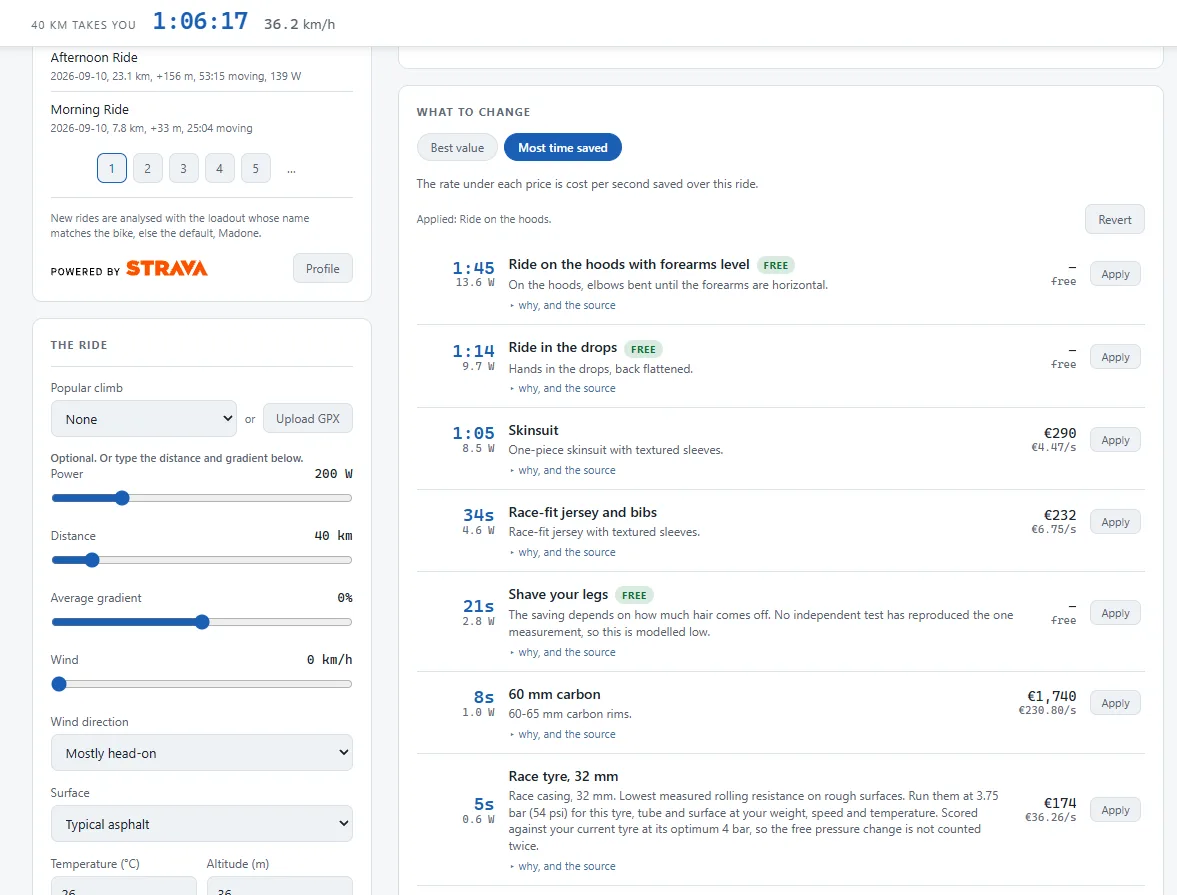
Marginal Watts answers the question every cyclist eventually asks in the wrong order. Instead of "how much faster are these wheels", it asks "of everything I could change on this ride, which change buys the most time per pound spent". Then it ranks them. Free changes like tyre pressure and riding position sit in the same list as a £2,000 wheelset, which is the point: the list frequently says the free thing first.
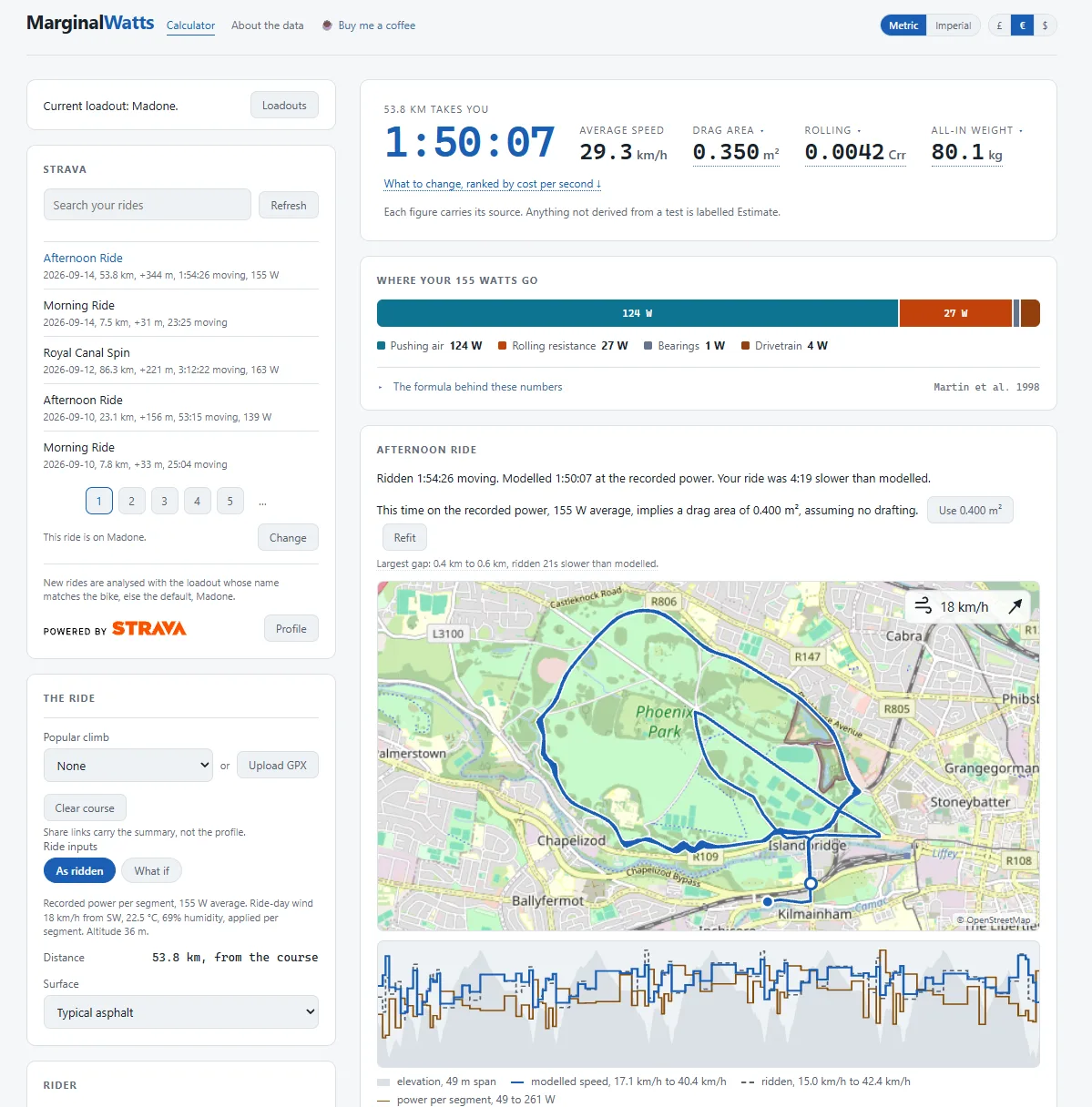
Underneath it solves the Martin et al. (1998) road cycling power model for your speed and time, then re-solves the same ride once for every compatible change and sorts the results. You describe the ride (power, distance, gradient, or pick a climb like Ventoux or Hardknott) and the setup, down to helmet, socks, frame, wheels, tyres, measured tyre width and pressure. It shows where your watts are actually going: pushing air, rolling resistance, bearings, drivetrain.
What makes it more than a toy is the sourcing. The figures come from a corpus of 1,383 published measurements drawn from 230 sources: drum tests, wind tunnel sessions, peer-reviewed papers. Each figure in the calculator carries its own source and grade. Two-thirds are peer-reviewed or independent lab work. 209 measurements are flagged for conflict of interest, meaning the publisher now sells the thing it measured. Anything not derived from a test is labelled an Estimate rather than dressed up as a measurement.
Key Features
Ranked by cost per second, not by watts
The output is a sorted list of changes with the time each one saves and what it costs to get. Free adjustments compete directly against expensive ones.
A power breakdown for your actual ride
Shows how your watts divide between aerodynamic drag, rolling resistance, bearings and drivetrain losses, for the setup you described rather than a generic rider.
Every number is traceable
Open any figure in the breakdown panel and you get its source, the count of comparable tests, and the date range behind it. 60 papers in the bibliography, each DOI checked against CrossRef.
Your measurements beat theirs
If you know a figure better (your bike on a scale, a drum-tested Crr, a measured drag area), you enter it and the model uses yours instead of the class figure.
Climbs and GPX built in
Preloaded profiles for Alpe d'Huez, Ventoux, Stelvio, Zoncolan, Angliru and more, or upload a GPX of your own route.
Documented ways to be fooled
The dataset flags 18 methodology traps, documented ways a published cycling number can be misread at face value. That's an unusual thing for a calculator to volunteer.
Who It's For
- Riders about to spend money who want to know whether the wheels or the skinsuit is the better buy, before buying either
- Time triallists and climbers chasing a specific course time
- The evidence-minded, who want to see the study behind a claimed watt saving rather than a brand's number
- Anyone with a floor pump, since pressure and position keep winning the ranking for free
Does Marginal Watts connect to Strava?
Yes. Connecting lets the calculator read your recent activities and pull the streams for a ride you pick. Your browser fetches them from Strava directly, and the server gets the course as a list of segments (length, gradient, headwind, altitude) rather than your coordinates. If you opt into ride annotations or ride history, the server fetches those rides from Strava to model them and keeps none of the streams. Ride annotations also write to Strava: the analysis goes into the description of new outdoor road and gravel rides, between its own two marker lines, leaving the rest of the description alone. They're off until you turn them on. The maker says the app was approved through Strava's API program in September 2026, so the beta cap on how many athletes could connect is gone. Uploading a GPX still works if you would rather not connect.
Is it free?
Yes, the whole calculator, with no account needed. There's a Buy Me a Coffee link if you want to support it, and that's the extent of the commercial side.
Where do the numbers come from?
A compiled corpus of 1,383 measurements from 230 sources: peer-reviewed studies, independent labs with published protocols, wind tunnel sessions, drum tests and some brand claims. A class figure is the median of comparable tests, shown with its count and date range. Where no usable measurement exists, the number is the author's reasoned estimate and is labelled as one everywhere it appears.
What does it store about me?
A plain connection stores nothing on their server. Opting into ride annotations or saved setups stores your Strava credential encrypted plus your preferences; opting into ride history keeps one row per ride (date, distance, moving time, average power, implied CdA, wind figure) with no coordinates, streams or names. A connection unused for 90 days is revoked and deleted automatically.
Do I need a power meter?
No. You give it a power number for the ride, and if you don't have one you can work from a figure you assume and compare the ranked changes, since the ordering is what matters. A power meter makes the absolute times more trustworthy.