The numbers come from Marginal Watts, a free calculator Seamus Woods built because nothing he could find would tell him what an upgrade would do to his own ride. It solves your ride with a published cycling power model (Martin et al., 1998), re-solves it once for every change you could make, and ranks the results by what each second saved costs, free changes in the same list as a carbon wheelset. Seamus is a software engineer in Ireland who rides. He launched it as a side project in August 2026 and answered our questions by email.
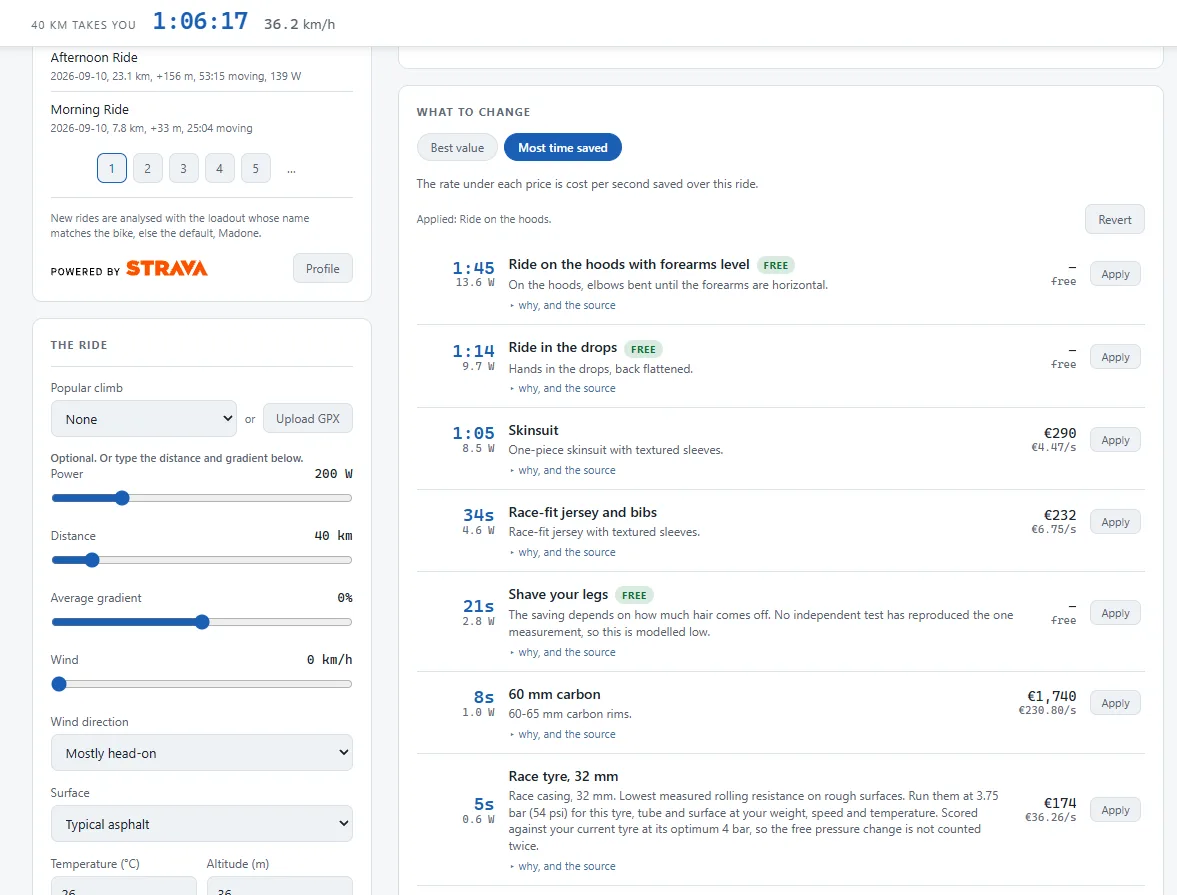
Forearms level: 2:11. A £4,000 aero frame: 2:10.
We asked for the highest-impact changes on a typical ride, and the thing people spend money on that doesn’t pay back. He started with a rider:
68 kg, round-tube endurance frame, shallow alloy wheels, 28 mm all-round tyres with butyl tubes, vented helmet, normal jersey, hands on the hoods. 40 km of flat asphalt at 200 W in a light quartering wind.
On the calculator that ride takes 1:22:31, about 29 km/h. The table shows 18 of the changes it offers him: free ones first, by time saved, then paid ones by cost per second. You can open the same rider and change anything.
| Change | Time saved over 40 km | Cost | Cost per second saved |
|---|---|---|---|
| Hoods, forearms level | 2:11 | Free | Free |
| Ride in the drops | 1:32 | Free | Free |
| Lower tyre pressure | 35 s | Free | Free |
| Shave your legs | 27 s | Free | Free |
| Latex inner tubes | 39 s | £24 | £0.61 |
| TPU inner tubes | 22 s | £36 | £1.66 |
| Wax the chain (pot and wax) | 20 s | £50 | £2.55 |
| Skinsuit | 1:22 | £250 | £3.07 |
| Race tyres, 28 mm | 45 s | £140 | £3.12 |
| Race-fit jersey and bibs | 43 s | £200 | £4.62 |
| Aero road helmet | 29 s | £150 | about £5 |
| Aero socks | 3 s | £30 | about £10 |
| Aero road frame | 2:10 | £4,000 | £31 |
| 60 mm carbon wheels | 37 s | £1,500 | £41 |
| 50 mm carbon wheels | 27 s | £1,300 | £48 |
| 35 mm carbon wheels | 17 s | £1,000 | £58 |
| Lightweight race frame | 49 s | £3,500 | £72 |
| Deeper alloy wheels | 6 s | £400 | £72 |
Figures from the calculator in September 2026, with typical prices for each kind of part. The pressure change is 6.5 bar (94 psi) down to 4.25 bar (62 psi); the calculator has a maximum-pressure box, worth filling in. Sort the same list by time saved instead and the £4,000 aero frame sits right under the forearms.
Position is most of the answer for most riders and it costs nothing. AeroCoach put the rider’s body at about 80% of the drag of the bike and rider together, which makes it the only large lever most people already own.
The poor use of money is wheels. £24 of latex tubes buys 39 seconds. £1,300 of carbon wheels buys 27. Wheels are the upgrade people save up for, and at every price they sit near the bottom of the list.
The sharpest version of it is on the page itself. Ranked by time saved, dropping your forearms is 2:11 and a £4,000 aero frame is 2:10, the row directly below it. Same ride, same rider. One of them is free.
Free changes being in the ranking at all is the part I would point at. They are ranked against the paid ones on the same axis, and most of the time they win. That is not a difficult thing to build. It is a difficult thing to publish if you are selling wheels, which is why most upgrade advice starts at the point where money changes hands.
One second apart is a tie. The site grades the size of the forearms figure an estimate, since no test has measured that exact position, but the direction has support. When BikeRadar took seven aero upgrades to the Silverstone wind tunnel in 2023 and ranked them by pounds per watt, the “aero hoods” position came first: 22.38 W at 35 km/h for nothing, more than twice what a £949 carbon wheelset saved. Only clip-on aero bars saved more (31.33 W, for £117).
One more free change sits outside the ranked list, in a table of its own on the front page: the state of your chain. Leave it dirty after a wet ride and the same rider loses 1:04 over the 40 km. A muddy one costs 1:52. That’s more than the latex tubes and a waxed chain save put together. The site flags those chain figures too, because the main sources sell the products they test, or are owned by companies that do.
Put the same rider on Sa Calobra
He was clear that none of this travels:
Those figures hold at 40 km and 200 W and are wrong elsewhere. At 100 km the same tubes are 1:39 and the same 50 mm wheels are 1:07. Which is the entire argument for solving your ride instead of reading mine.
So we moved him to Sa Calobra in Mallorca, one of the twelve climbs built into the site, and got a different list.
| Change | Saved, 40 km flat | Saved, Sa Calobra | Cost per second, Sa Calobra |
|---|---|---|---|
| Hoods, forearms level (free) | 2:11 | 8 s | Free |
| Lower tyre pressure (free) | 35 s | 20 s | Free |
| Latex inner tubes (£24) | 39 s | 21 s | £1.14 |
| Wax the chain (£50) | 20 s | 25 s | £1.98 |
| Lightweight race frame (£3,500) | 49 s | 47 s | £74 |
| Aero road frame (£4,000) | 2:10 | 27 s | £148 |
| 60 mm carbon wheels (£1,500) | 37 s | 6 s | about £230 |
Same rider and kit at 200 W. Sa Calobra averages 7% and takes this rider 49:38, at 11.6 km/h. The best pressure is 4.25 bar on both rides. Open the climb version.
At 11.6 km/h there isn’t much air to cheat, so the forearms are worth 8 seconds and the £1,500 wheels 6. The biggest saving on the climb is the lightweight frame, 47 seconds, largely because it’s 1.4 kg lighter. The waxed chain moves up: it saves the same 1.8 W wherever you ride, and on a climb a spare watt buys more speed than it does against the wind. The best value is still free, though. Letting the tyres down saves 20 seconds, more than any change of position.
On a 7% average the weight term starts mattering and the aero term stops. Most kit advice is implicitly about flat riding and never says so.
Are aero socks and ceramic bearings worth it?
Of the 1,383 measurements behind the calculator, 209 carry a flag: the publisher now sells the product it measured. We asked what stood out in the research, and Seamus started with aero socks.
Against normal socks, Rule 28’s own 2020 test found its aero socks saved just over 2 W at 40 km/h. BikeRadar’s 2023 wind tunnel test of the same brand’s socks found 0.33 W at 35 km/h. Rule 28’s newer figures of 10 to 12 W answer a different question: they’re measured at 45 km/h against its own previous aero sock.
The calculator has aero socks at 3 seconds over 40 km for £30, because that is what the independent number supports.
Ceramic bearings came next. CeramicSpeed says its bearings in the hubs, pulleys and bottom bracket save 6 to 9 W together, compared with standard bearings. Friction Facts, a Colorado lab that tested drivetrain parts, found 0.03 W between the best steel bottom bracket and the best ceramic one across 35 models from 12 makers, and for three of the five makers that sold both, steel had less drag. Its pulley test put ceramic 0.013 W ahead per pulley. The calculator doesn’t offer a ceramic upgrade at all: bearings cost this rider about 1 W in total, and the site says no published figure separates good bearings from bad. The lab’s history is what stayed with him.
It was genuinely independent from 2012 to 2016 and bought its test samples at retail. CeramicSpeed acquired it in November 2016 and its founder became CeramicSpeed’s CTO. friction-facts.com is dead, so a large share of the drivetrain data the sport still quotes survives only as PDFs hosted by a component manufacturer. None of that makes the measurements wrong. It makes them worth labelling, which is all the flag does.
The trap he thinks costs riders most is a duller one.
Bicycle Rolling Resistance publishes single-tyre watts at a 42.5 kg load. AeroCoach publishes per-pair at 45 km/h. Doubling, or failing to double, is a 100% error, and nothing on the page tells you which one you are holding. There are 18 traps of that kind written up on the site, and they are the reason this is a solver with a corpus behind it rather than a spreadsheet.
Every figure in the calculator opens to show its source, the test conditions and whether the number was measured or estimated. If you know better, a bike on a scale or a drag area from an aero session, you type in your own.
Loading a real ride from Strava
We asked what connecting Strava adds.
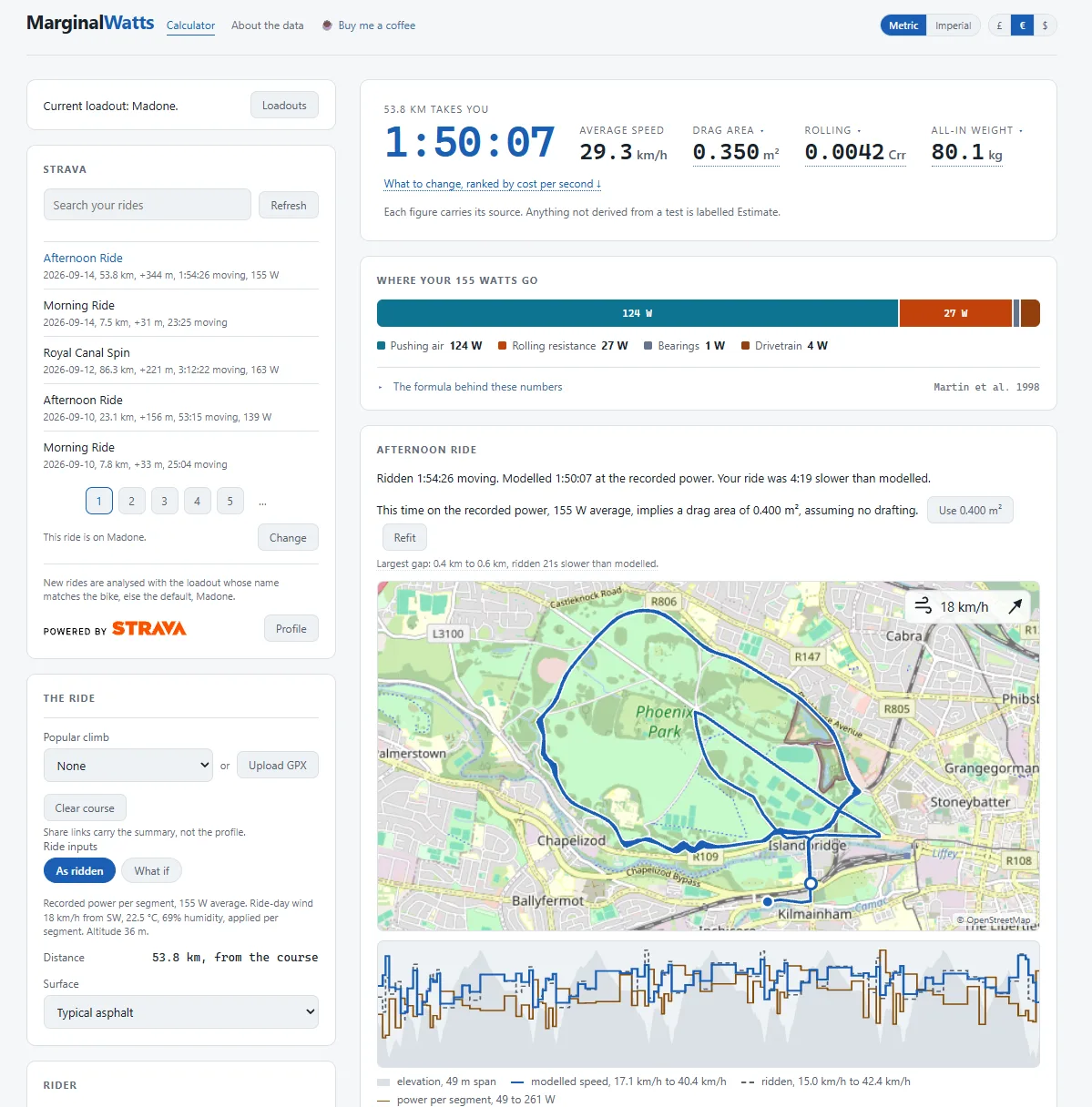
It moves the question from a hypothetical ride to one you actually did. Pull in a real ride and it loads as ridden: the recorded power shape segment by segment, the wind for that place and each of those hours from Open-Meteo applied per segment rather than as one average, and the ride’s own temperature and humidity at the course’s altitude. Then the upgrade list re-solves that same real ride with each change swapped in. Not 40 km of imaginary flat road, but the ride you did on Sunday, with its climbs and its headwind, and what each change would have taken off it.
Second, it checks itself in public. If you turn on activity descriptions, which takes a second Strava authorisation and is off until you do, each new ride gets the analysis written into its description. That block carries the modelled time next to what you actually rode, and the gap:
⏱️ Modelled 2:13:51 (Your ride was 16s slower)
That is the model’s error, on every ride, on your own rides, where anyone following you can see it. If it is wrong, that line says so and I hear about it. I do not know of another tool in this space that publishes its own residual by default, and I would rather be embarrassed by a bad line than quietly wrong.
How it spread
Reddit gave the first proper spike. Word of mouth has been the steadiest, and I think that is partly a design accident: the whole setup encodes into the URL, so sending someone your bike is one click, and a lot of the sharing has been people settling arguments about wheels with a link. Search has grown slowly and is the one still growing.
The Reddit post that took off was in r/Strava in August. Riders asked for aero socks and shaved legs as options, and both are in the calculator now. A couple tested it against rides they’d already done. One found it within a minute on a 15 km time trial and under 10% out on most 70 to 90 km rides, with hilly rides about 20% off until they loaded the GPX, which brought them back to around 10%. Another said it came very close to their 40 km time trial.
He counts about 3,000 visitors since August, “the honest upper bound rather than three thousand people who sat and configured a bike.” Riders pay nothing, and there’s a Buy Me a Coffee link if they want to.
There is nothing to buy here. No affiliate links, no ads, no sponsored placements, no shop. That is why the ranking can put four free changes above a £4,000 frame and leave them there.
And what he’d ask you to try:
Load a ride you have already done and watch the list re-rank itself against that ride, then do the same for a climb you are planning next month. The answers differ, and both differ again from the generic figures everyone quotes. Most riders find at least one free change worth more than the thing they were saving up for, which is either useful or annoying depending on how recently they bought wheels.
Other questions
Is tubeless faster than latex inner tubes?
On Marginal Watts they come out level. For the site’s own reference rider (68 kg, on an aero road bike), both save 39 seconds over 40 km; tubeless costs £40 and latex £24. Both figures come from Bicycle Rolling Resistance drum tests. Tubeless needs tubeless-ready rims and tyres, and latex loses pressure overnight.
Does shaving your legs make you faster?
A little, on the evidence there is. Marginal Watts gives it 27 seconds over 40 km for the rider in this post and grades the figure an estimate. Published figures span roughly a factor of ten. The only measured before-and-after pair is one rider in Specialized’s own wind tunnel, reported by BikeRadar, and no independent test has reproduced it, so the model uses a value near the bottom of the range.
Do you need a power meter to use Marginal Watts?
No. You type in a power figure, so without a meter you can put in your best guess. If you turn on ride history, outdoor rides recorded without a power meter are stored with watts the model estimates. The seconds are only as good as the power you give it, so a power meter makes them more trustworthy.
Sources
- Written answers from Seamus Woods, September 15, 2026
- Marginal Watts, re-run September 26, 2026, with its About the data, support and privacy pages, and its answer pages on forearms on the hoods, tyre pressure, latex tubes, tubeless and shaving your legs
- BikeRadar: The best-value aero upgrades, wind tunnel tested and ranked (March 2023)
- Rule 28: Aero sock testing (August 2024) and BikeRadar on Rule 28’s 2020 sock test
- CeramicSpeed: How to save watts
- BikeRadar: Friction Facts, measuring bottom bracket drag (December 2013) and CeramicSpeed: 11-tooth derailleur pulley wheel efficiency test
- Cyclingnews: Friction Facts, measuring drivetrain efficiency (November 2012) and Bicycle Retailer: CeramicSpeed acquires Friction Facts (November 2016)
- Bicycle Rolling Resistance: Our tests explained and AeroCoach: Inner tube rolling resistance
- AeroCoach: Learn, on the body as around 80% of drag
- Seamus’s r/Strava launch thread (August 11, 2026)
- Martin et al. (1998), Validation of a Mathematical Model for Road Cycling Power
More cycling and power tools that connect to Strava are in the directory.