At 04:58 on Wednesday, September 16, a coach called Ben sent Felix a message. Seven hours 35 minutes of sleep, score 89. HRV of 74 ms on his Garmin, “remaining high” after 68 and 76 the two nights before. Resting heart rate 42, one beat over his baseline. The previous day’s ride had been easy: 1:28 at 225 W weighted power. The reason for the message came last. Thursday’s 65-minute time-trial session was down for 17:20, and his calendar had an appointment at 17:30. Which other window worked?
Ben is software, the coach inside YOUB. Felix is Felix Hermanutz, one of its co-founders, who in 2019, at 21, won the men’s amateur title at King of the Lake (the pros race separately), the 47.2 km time trial around Austria’s Attersee.
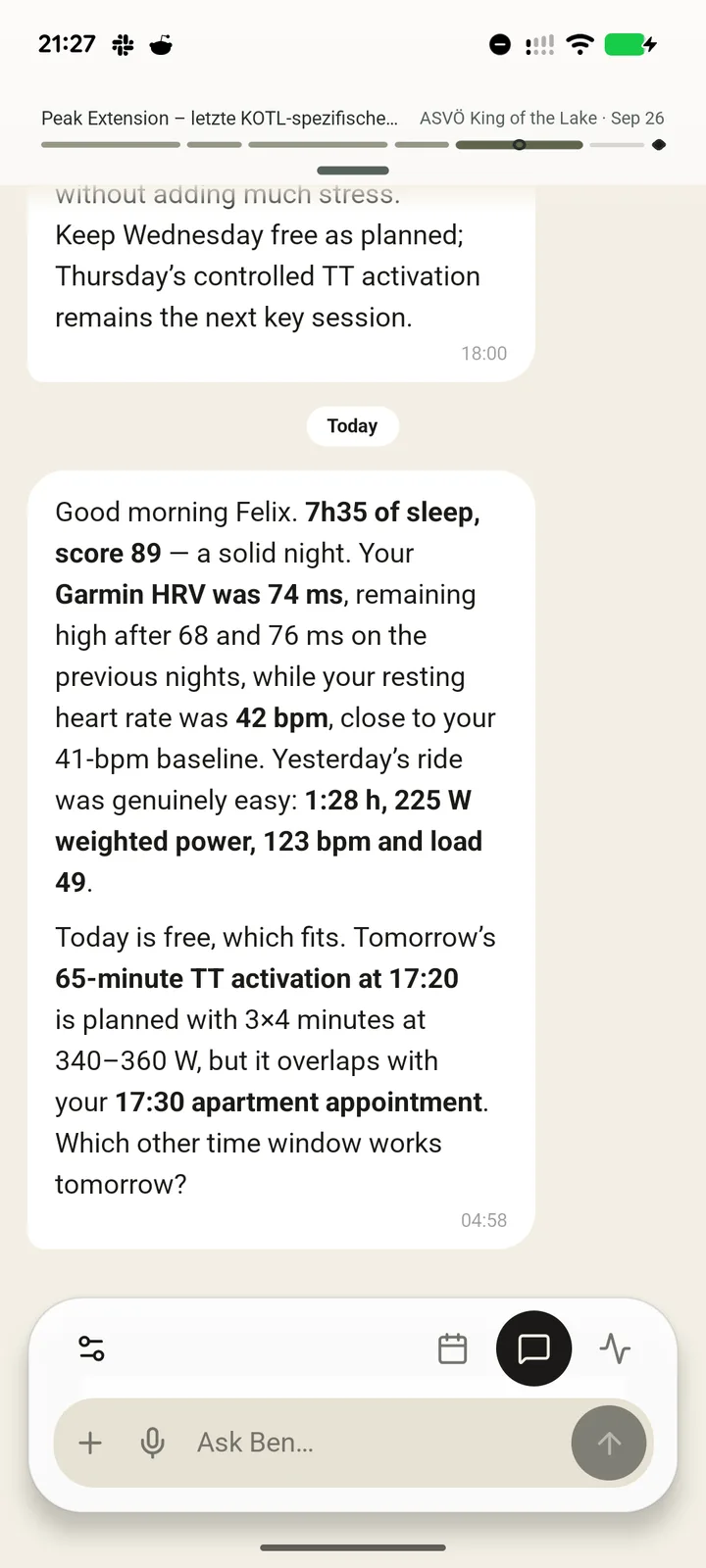
Thomas, also a co-founder, sent us that screenshot with written answers to our questions. He’s a former professional athlete and a software engineer, by his own account, and he puts the team at five people and the athletes training with YOUB at around 500. His answers are in his own words, lightly trimmed. We checked prices, devices and features against youb.app and the app stores in October 2026; anything we couldn’t check is attributed to him.
The coach you hire for one season
We asked what made him build it. He started with his own career and ended on price.
As a professional athlete I had that kind of support every day: someone who knew me, knew my training, and told me the truth about it. After my career I saw how many ambitious amateurs wanted exactly that. Most competitive endurance athletes have had a coach at some point. Someone who helped them work on their weaknesses, get into structured training and stay on track towards their goals. But at €200 to €350 a month, a dedicated coach prices out most people, so many take one for a single season and then drop it.
His range sits in the middle of what coaching companies publish. At McMillan the price tracks who the coach is: $99 a month gets you one of its certified coaches and $199 one of its staff coaches.
| Who | Per month |
|---|---|
| McMillan Running (US, running) | $99 to $399 |
| TrainingPeaks Coach Match (US, accredited coaches) | $149 to $359 |
| Synergy ProTraining (Germany, cycling, running, triathlon) | €109 to €369 |
| CTS (US, cycling, running, triathlon) | $225 to $1,295 and up |
| YOUB, with its coach | €29 billed yearly, €35 month to month |
| YOUB, with your own Claude or ChatGPT | Free (some assistants need a paid plan) |
Coaching prices from each company’s own pricing page. CTS’s are for a 12-month agreement. YOUB’s yearly plan is €349 up front, which is where the €29 comes from, and both YOUB plans start with a 14-day trial.
What “not yet” means
We asked Thomas what YOUB does that other AI coaching apps don’t. He started with sport-science expertise, the experts YOUB works with to validate its planning, and then set a bar rather than naming a feature.
We hold ourselves to a clear standard: a training experience on par with a human coach. We are not there yet, but that is the bar. In its essence, YOUB is a continuous reflection system that gives you feedback, has your back when it gets tough, and provides structure in daily uncertainty so an athlete keeps making consistent progress. All the things most athletes try to get from human coaches as well.
YOUB’s own site says the same. Its FAQ says YOUB “is not meant to replace every part of a human coaching relationship”, and pitches it at the gap where personal coaching is too expensive, unavailable or too slow for daily changes. Its page on human coaches is specific about where a person still wins: “For injuries, medical questions, complex special cases, or elite setups, a human coach or medical advice can still make sense.” Felix’s February post on the YOUB blog, subtitled “Do we still need real coaches?”, goes further: human coaches “remain irreplaceable for many athletes due to their empathy, relationship-building, and responsiveness to emotional needs.” Cycling Weekly’s look at AI coaching platforms in March 2026 came out in a similar place, concluding that platforms blending AI and human coaching work best.
The limits he’d set are short:
Anything medical. If you are injured or sick, the coach should send you to a doctor, not diagnose you. And on the days when you just want to ride, it should not turn every session into a lesson. A good coach knows when to say nothing.
The medical half is written into the site: YOUB “provides coaching suggestions, not diagnoses”, and pain, illness, injury and medical questions “belong with qualified medical professionals rather than an automated training decision.” The other half, a coach that leaves an easy ride alone, can’t be judged from screenshots; it would take weeks of use.
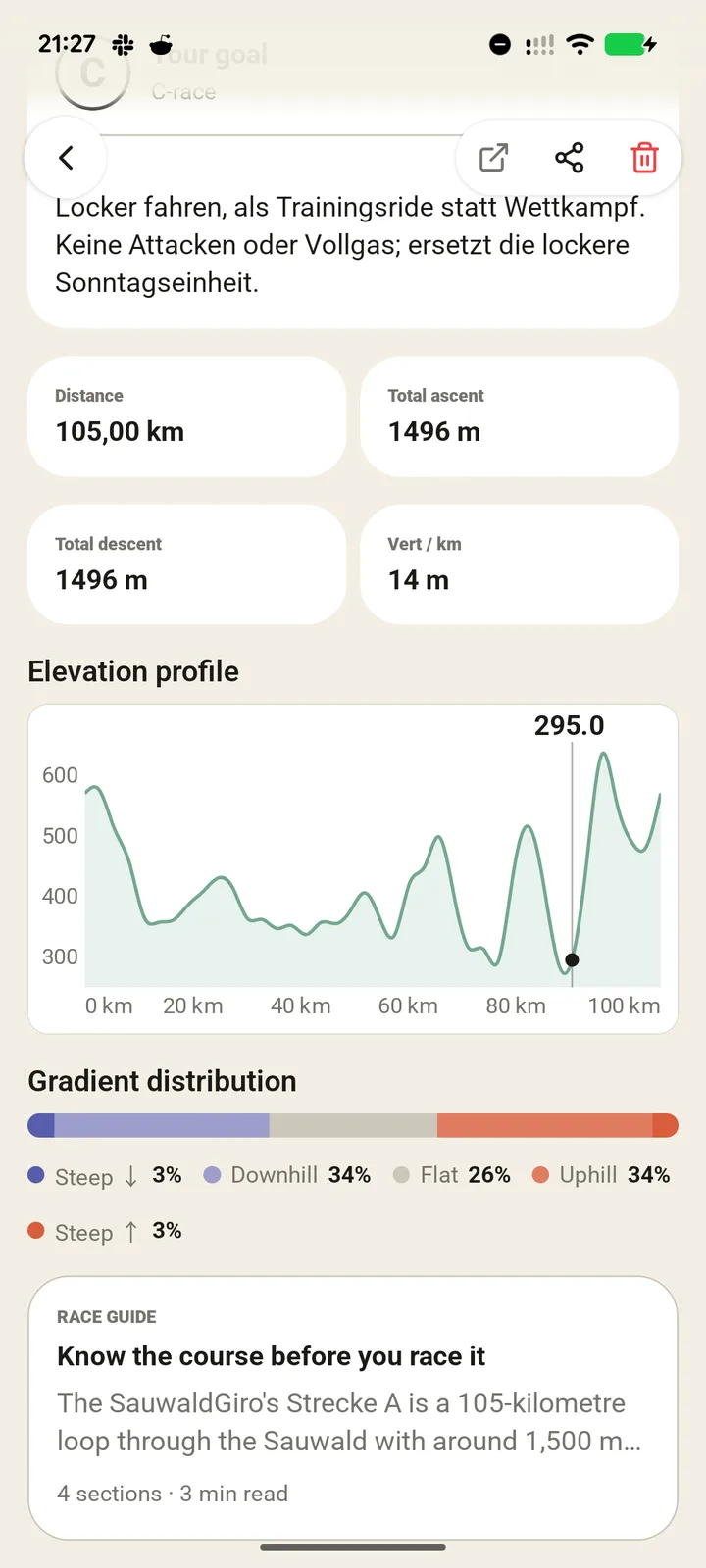
One of the screenshots shows how Felix’s plan handled an event that wasn’t the goal. The SauwaldGiro on August 30, a 105 km loop with 1,600 m of climbing by the organiser’s figure, was in the plan as a C race with one note, in German: ride it easy, as a training ride rather than a race, no attacks, no full gas, and it replaces the easy Sunday session.
What Ben does with a ride
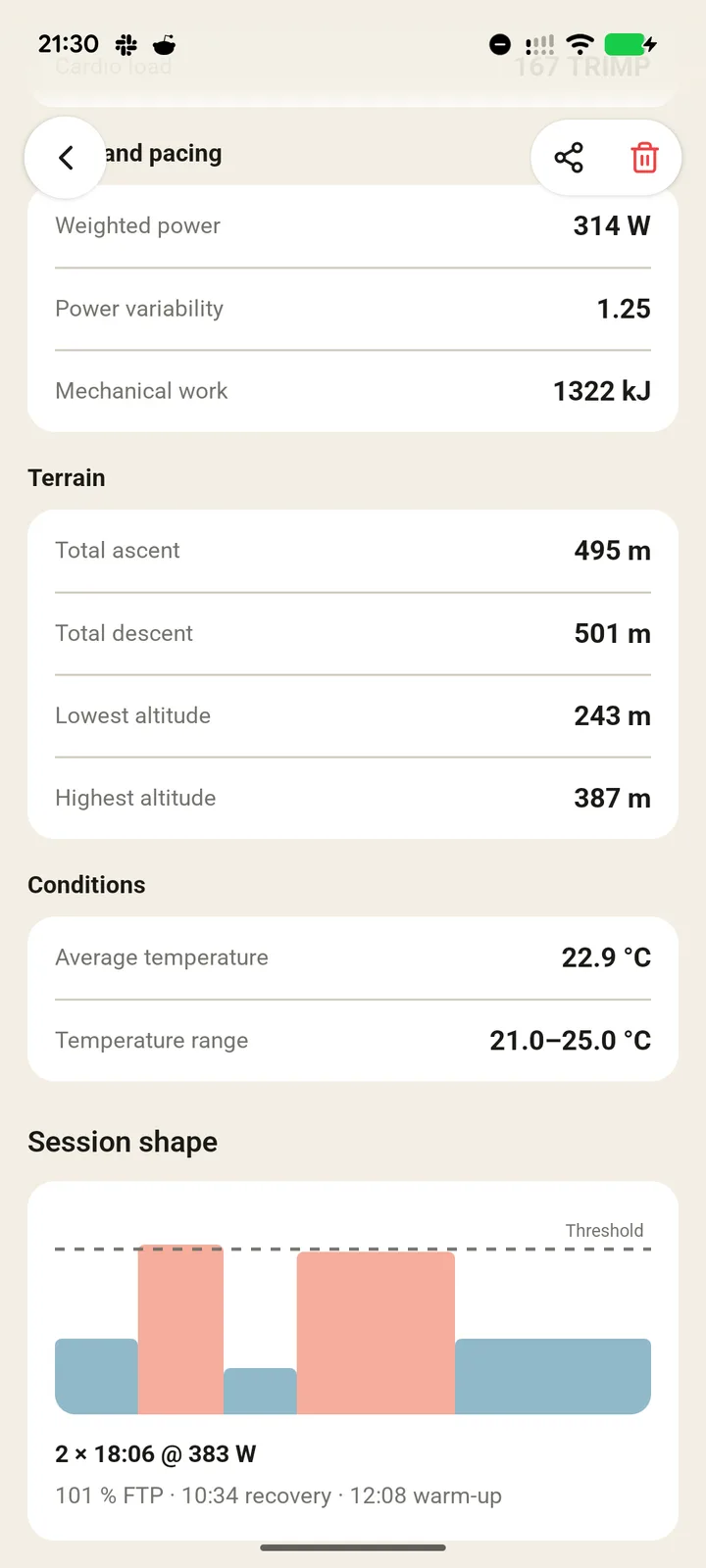
YOUB’s homepage describes a coach that “checks in after your sessions”. For a Strava activity, Thomas says it goes like this:
First it goes through a lot of statistical analysis. Load, impact, effort level, and so on. All of that is enriched before it is passed on to the coaching engine. Then we mix in context. What was on the plan? What does the structure of the session actually look like? Which markers and metrics are out of the ordinary?
With all that enrichment, partly static and partly through AI, we relate the session to the athlete’s goals and progress. We congratulate on hard sessions, we ask when something was skipped or cut short, and we make sure the training effect still fits the rest of the week’s plan.
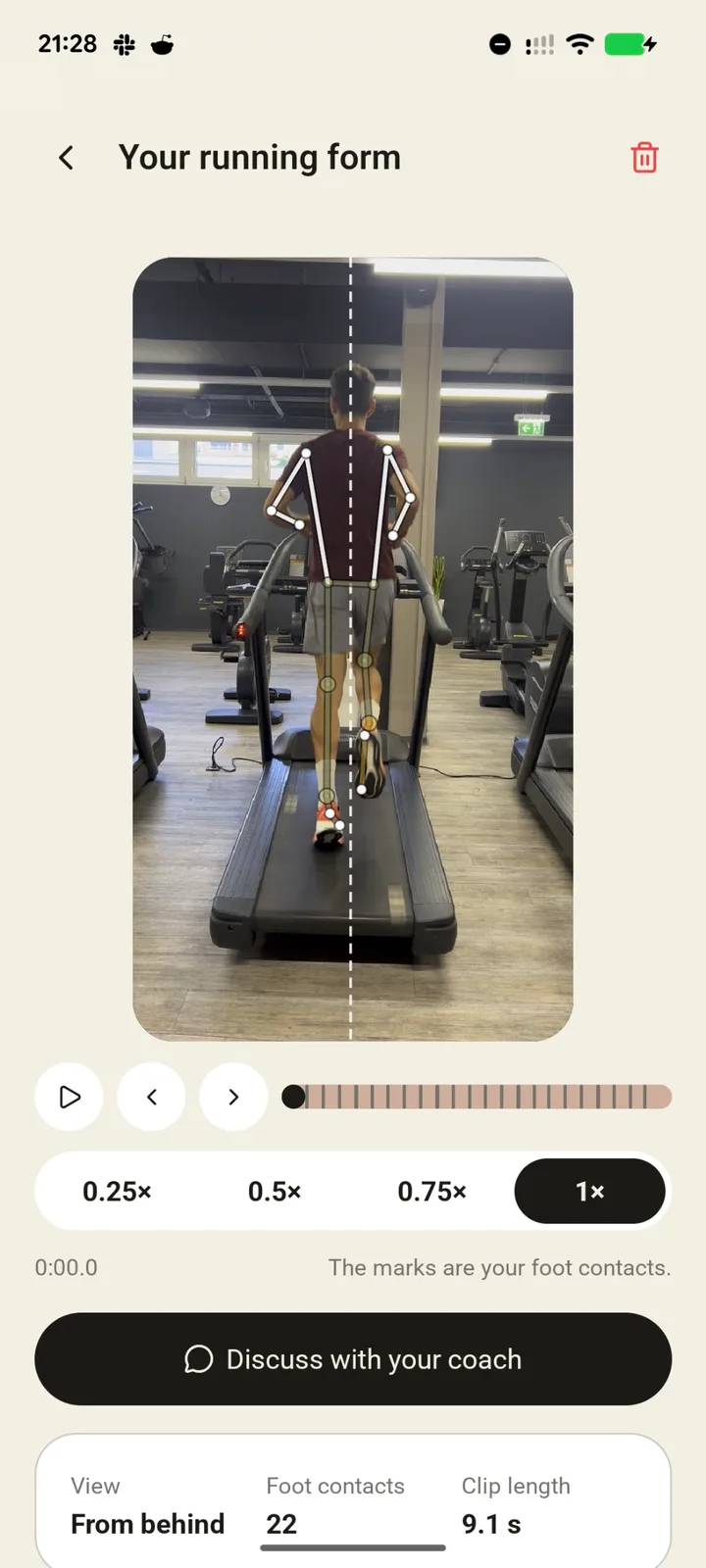
The screenshots here are a cyclist’s, but YOUB is built for runners and triathletes too, and runners get video analysis of running form, with a button that sends the result to the coach.
Two ways to use it
YOUB also has a free version, without Ben. Thomas:
If you would rather train with Claude or ChatGPT than with our coach, YOUB is free. Your LLM of choice creates your training, syncs to and from your devices, and shows your plan and progress in the YOUB apps.
It works over MCP, the standard that lets an assistant use outside tools. You add mcp.youb.app to Claude or ChatGPT as a custom connector, confirm with a code on your phone, and your assistant can read your sessions and recovery trends, plan structured workouts, rebuild the week and set a race as a goal. Reading is the default. Writing to your plan needs a separate permission for each kind of data.
| YOUB’s coach, Ben | Your own Claude or ChatGPT | |
|---|---|---|
| Cost | €29 a month billed yearly, or €35 monthly, after 14 days free | Free from YOUB; you need an assistant that allows custom connectors (on ChatGPT, a paid web plan) |
| Who decides | Ben, on what YOUB calls sports-science decision logic | Your assistant |
| Where you talk to it | The app or WhatsApp, and Ben messages first | Your assistant’s chat, when you ask |
| Workouts on your device | Pushed to your watch or head unit, Thomas says | Garmin, Wahoo or Suunto, per YOUB’s setup page |
| Safety net | YOUB says sports-science rules sit behind every recommendation, and medical questions go to a doctor | None, by YOUB’s own description |
YOUB’s setup page says as much. What comes back “is your assistant’s answer, not ours. It has no injury guardrails, no sports-science review behind it, and no way to tell a real number from a plausible one.” Strava has its own connector for Claude and ChatGPT, which reads Strava data and nothing else; our guide to connecting it covers setup, and we collected prompts that work with it.
Independent word on YOUB is thin. On the Austrian App Store it has ten ratings, all five stars. When the free connector went up on the intervals.icu forum in September, an early tester reported a login bug and a profile that didn’t load his own values; someone from YOUB’s team answered in the thread and said the profile now refreshes from intervals.icu.
The Strava API was the easy part
We asked what the hardest technical problem was and suggested webhooks, rate limits or getting a model to reason about training load. He waved off the first two.
The Strava integration itself was straightforward. The API is well specified and webhooks are easy enough to implement.
The stack has grown with our needs and is fairly complex by now. It is mainly NestJS, Postgres, React Native and Nuxt. On top of that there are several native modules for Android (Kotlin) and iOS (Swift), plus a bespoke evaluation harness so we can verify the coach’s behavior in different situations.
One of the trickiest pieces is our custom LLM harness with its context and memory management. It is what lets us use stronger models, because we can make the coach very token-efficient and always have the right context in front of it.
But honestly, the hardest problem is not a piece of code. It is managing the complexity of an LLM-native application. LLMs are unpredictable. They always produce output, no matter what you feed them. Verifying correctness is much harder than with statistical models, which simply fail on unusable data instead of producing a confident bad answer.
That is why we work closely with sport-science partners in Austria to validate our planning process and training recommendations, and why we feed the coach hundreds of skills and behavioral requirements to make sure the advice is sound.
YOUB’s site doesn’t name those partners; it says the app was developed “together with sport scientists and doctors from sports science and real coaching practice.”
And his advice for anyone about to build on the Strava API:
There is no better time than now. Join a community, get started, and build what you would want to use yourself. Chances are other people want it too.
The API is the easy part. The hard part is everything on top: athletes have data spread across three or four sources, none of it clean, and they judge you on whether you understood their session, not on whether you synced it. Build actual intelligence and understanding.
Devices, language and beginners
Is YOUB good for beginners?
YOUB says it isn’t, for now. Its homepage lists three kinds of people it’s not for yet: anyone just starting endurance training, anyone who doesn’t use training data or a wearable, and anyone who wants to train without structure. It’s built for runners, cyclists and triathletes who already train toward a goal and already collect the data.
Does YOUB work with COROS or Apple Watch?
YOUB’s site still marks COROS as coming soon, though Thomas told us in September that COROS watches already sync. Apple Watch and Apple Health aren’t on YOUB’s list, which is Garmin, Strava, WHOOP, Oura, Polar, Suunto and Wahoo. The app’s September 25 update added a Hammerhead Karoo connection.
Is YOUB only for German speakers?
The website is in German and English, the iPhone app lists English as its language, and the race calendar reaches well beyond Austria, with events in Italy, the US, the UK, France and Spain as well as the German-speaking countries.
What does YOUB take from Strava?
YOUB’s Strava page says it uses your completed sessions: sport, duration, distance, elevation and intensity, and how your load builds over weeks. It describes reading only. Sleep, HRV and recovery don’t come from Strava, so with Strava as your only source the coach works from activities and what you tell it.
Sources
- Written answers from Thomas, co-founder of YOUB, September 16, 2026, and the screenshots he sent with them
- YOUB: pricing, MCP setup, FAQ, how it works, Strava, human coach and race calendar pages, and Between algorithms and empathy on its blog
- YOUB on the App Store (prices, ratings, version history) and on Google Play
- King of the Lake 2019: OÖN and meinbezirk.at; ASVÖ King of the Lake; SauwaldGiro 2026
- Coaching prices: McMillan Running, TrainingPeaks Coach Match, Synergy ProTraining, CTS
- Cycling Weekly: how cycling coaching platforms are changing the way we train, March 2026
- intervals.icu forum: YOUB’s free MCP connector thread