What is YOUB?
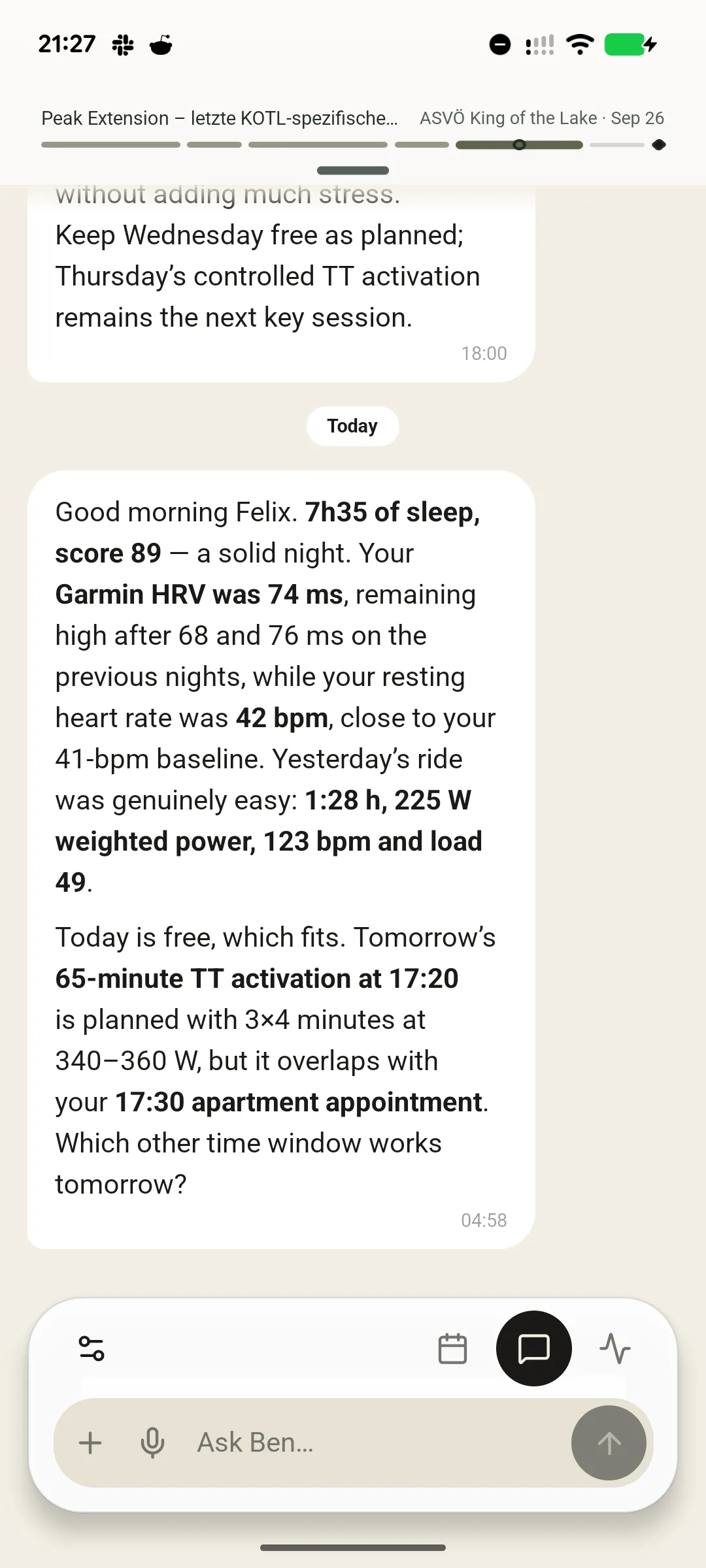
YOUB is a chat-first coach for runners, cyclists, triathletes, cross-country skiers and Hyrox athletes. There's no plan grid to open every morning. The coach, called Ben, messages you in the app or over WhatsApp: how did that ride feel, you slept badly again, Thursday's session doesn't fit, here's what I'd do instead. The plan gets built through that conversation in the first place, after a few starting questions about max heart rate, age, weight and height.
What's underneath it is your data. YOUB reads training from Garmin, COROS, Polar, Suunto, Wahoo, Hammerhead Karoo, Strava, WHOOP, Oura, Apple Health, Withings, Intervals.icu, Rouvy or Hevy, and it reads your Google Calendar to see where the training time actually is. When it wants to change something, it compares planned load against sleep, HRV, recovery, what you actually completed, what you've told it, and how much time you have, then proposes keeping, moving, shortening, or replacing the session, with the reasoning attached rather than a silent edit to your week.
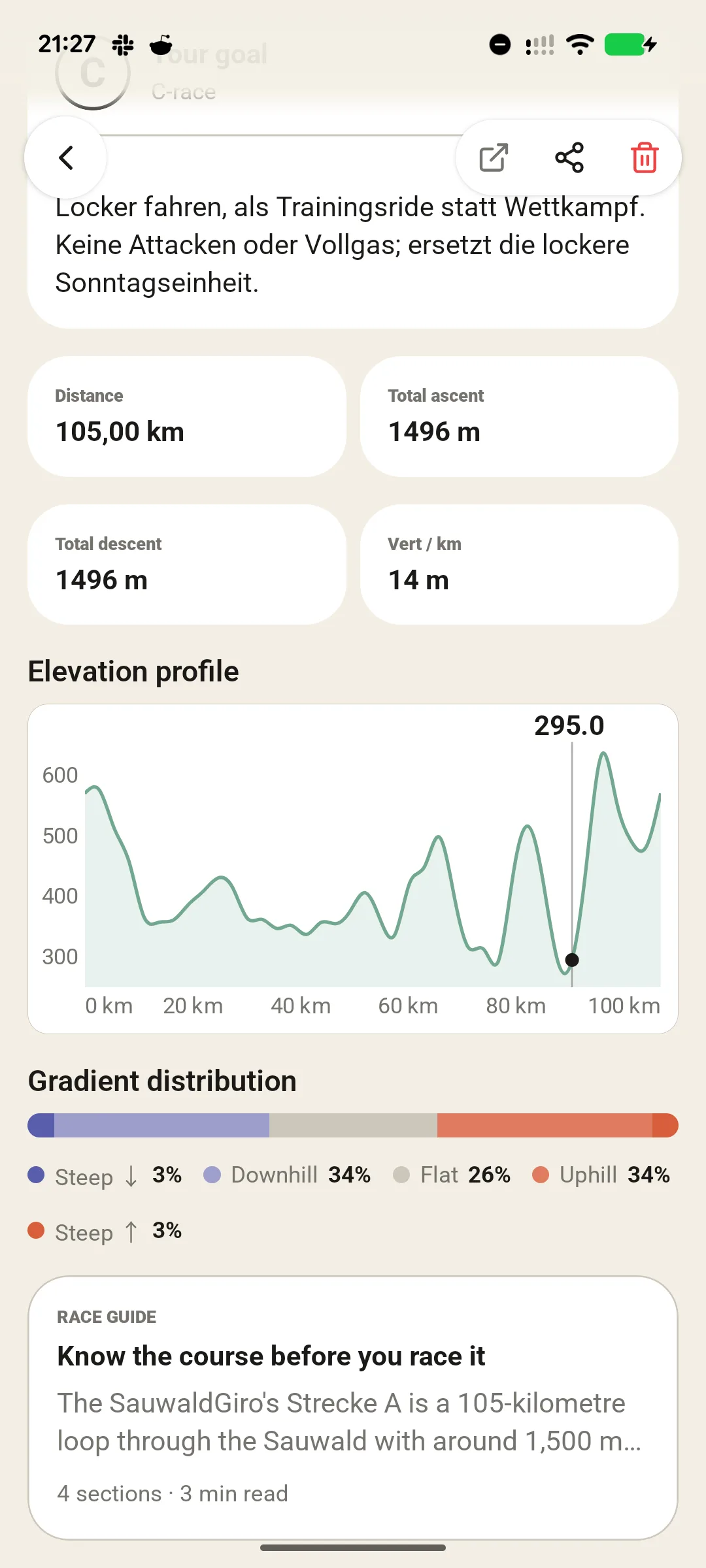
The iOS app landed in May 2026 and was rebuilt as a fully native app in August, and it's built in Austria, which shows in the race calendar: it started with 80+ running, cycling and triathlon events across the DACH region, with course profiles and the buildup to match, and now also lists races in Italy, the US, the UK, France and Spain. Planned sessions go to Garmin, COROS, Wahoo, Suunto and Hammerhead Karoo devices as structured workouts, and through Intervals.icu to Zwift.
There's also a way to use it without the coach. YOUB publishes an MCP server at mcp.youb.app; add it to Claude or ChatGPT as a custom connector and your own assistant reads your sessions, plans workouts, rebuilds the week and sends sessions to your watch, with the plan showing in the YOUB apps. That tier is free. YOUB's own caveat is that the response comes from your assistant, not from YOUB, and that training decisions stay yours; for qualified coaching it points you to the YOUB coach.
Key Features
Coaching that arrives, rather than waiting for you
Ben starts the conversation: after a session, when recovery numbers drop, when the week looks unrealistic. In the app or on WhatsApp, whichever you're already looking at.
A plan that moves when your week does
Tell it your legs are wrecked or that a work trip ate Thursday, and it reworks the week around the goal instead of leaving you to improvise or bail. Sessions get kept, moved, shortened, or swapped.
Calendar-aware scheduling
Google Calendar integration means meetings, travel and family time are part of the input. The coach knows a two-hour session doesn't fit Wednesday before it prescribes one.
Explanations instead of a verdict
Every adaptation comes with why the change was made, what risk it avoids, and what it protects, plus a follow-up question when the data doesn't tell the whole story.
Recovery signals in context
Sleep, HRV and recovery from your wearable are weighed against training load rather than shown as another number to interpret yourself.
Race calendar
Over 80 events in the German-speaking countries, and more across Europe and the US, with distances, elevation, and the training approach each one asks for.
Workouts on your watch
Planned sessions land on Garmin, COROS, Wahoo, Suunto or a Hammerhead Karoo through your existing connection, with intervals, repeats and targets by heart rate, power or pace, and reach Zwift through Intervals.icu.
Bring your own Claude or ChatGPT
Free over MCP: your assistant does the planning and analysis against your YOUB data, and you skip Ben. Reads are the default; writing to your plan needs a separate grant per category, revocable in the app.
Who It's For
- Athletes with a real race date (marathons, cycling events, long-course triathlon) who want the buildup to survive a normal, busy year
- People who won't open a dashboard but will answer a message
- Data-rich, time-poor trainers already wearing a Garmin, WHOOP or Oura who want something to actually decide with it
YOUB is direct about who it isn't for: their site says skip it if you're just starting out in endurance sport, don't use a wearable or training data, or deliberately train without structure.
What does the Strava connection actually do?
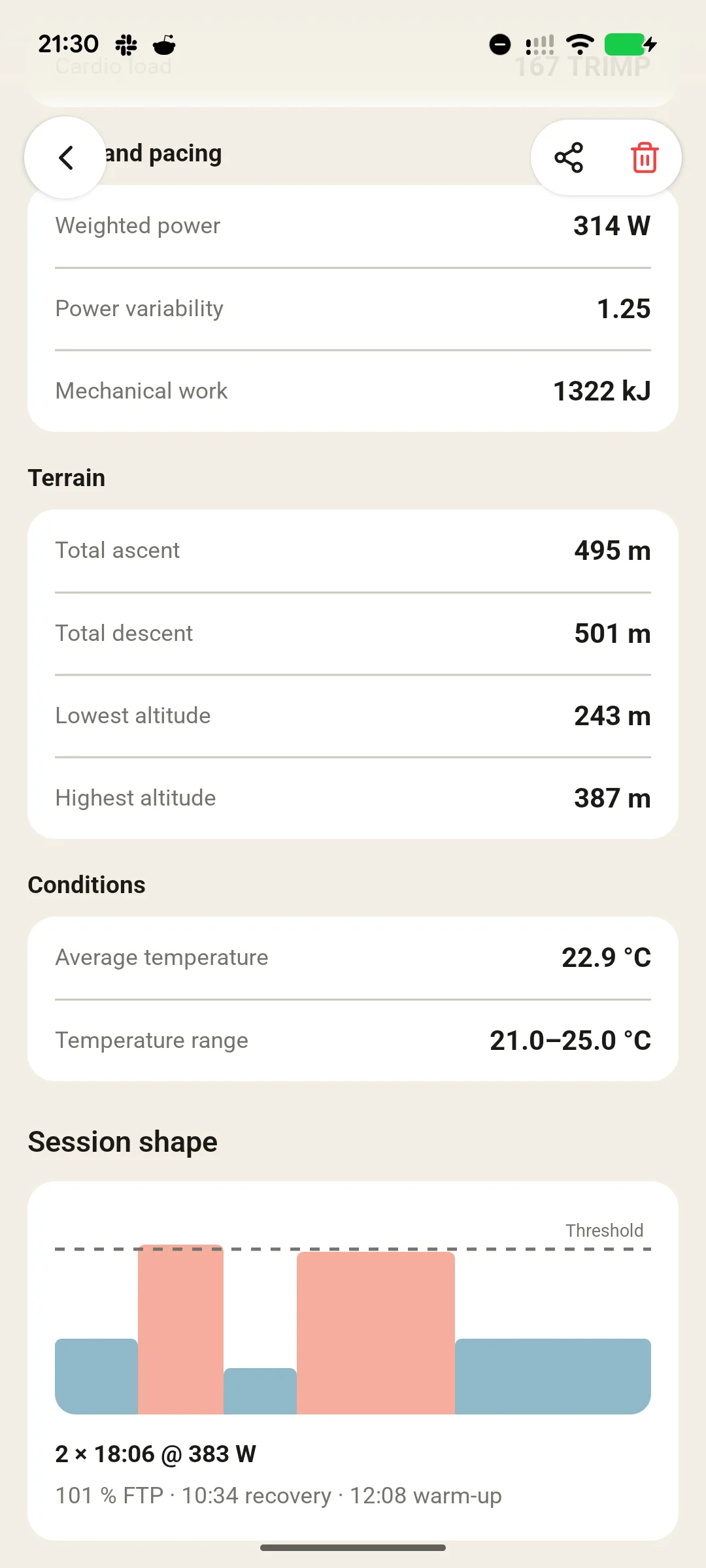
It reads. YOUB pulls your completed sessions (sport, duration, distance, elevation, intensity context) and uses them to understand your training history and multi-week progression, then asks whether a session felt too hard, about right, or too easy. Nothing is written back to your Strava account. Sleep, HRV and recovery don't come from Strava, so if that's your only connected source the coach is working from activity data plus what you tell it. Onboarding is built around Garmin; Strava works as a source alongside or instead of it.
How much is it, and is there a free tier?
The coach costs €29/month billed yearly or €35/month billed monthly, after a free trial with full access of up to 2 weeks, depending on usage, with unlimited messages either way. Apple's listing prices it the same: €35.00 a month or €349 a year, plus cheaper partner-code tiers from €26 a month. The free tier is the MCP route: if you already pay for Claude or ChatGPT, you connect mcp.youb.app to it and your assistant plans and analyses instead of Ben. On ChatGPT that needs developer mode, which is on the paid web plans only.
Does it send workouts to my watch?
Yes, to Garmin, COROS, Wahoo, Suunto and Hammerhead Karoo as structured workouts, and through Intervals.icu to Zwift. Planned sessions go through your existing connection and sit on the device on the day, with full structure: intervals, repeats, and targets by heart rate, power or pace. Polar, WHOOP, Oura, Apple Health, Withings, Rouvy, Hevy and Strava are data sources coming in, and Intervals.icu syncs activities in both directions.
Is it a replacement for a human coach?
YOUB doesn't claim to be. Their framing is that it covers the day-to-day (adapting the plan, explaining decisions, answering at 6am) where a human coach is expensive, unavailable, or too slow for a same-day change. It's also explicit that it gives coaching suggestions, not diagnoses: pain, illness and injury belong with a clinician.
Does it work in German?
The site ships in German and English, the company is Austrian, and most of its users are in the DACH region. Note that Apple's App Store listing declares English as the iOS app's only bundled language.