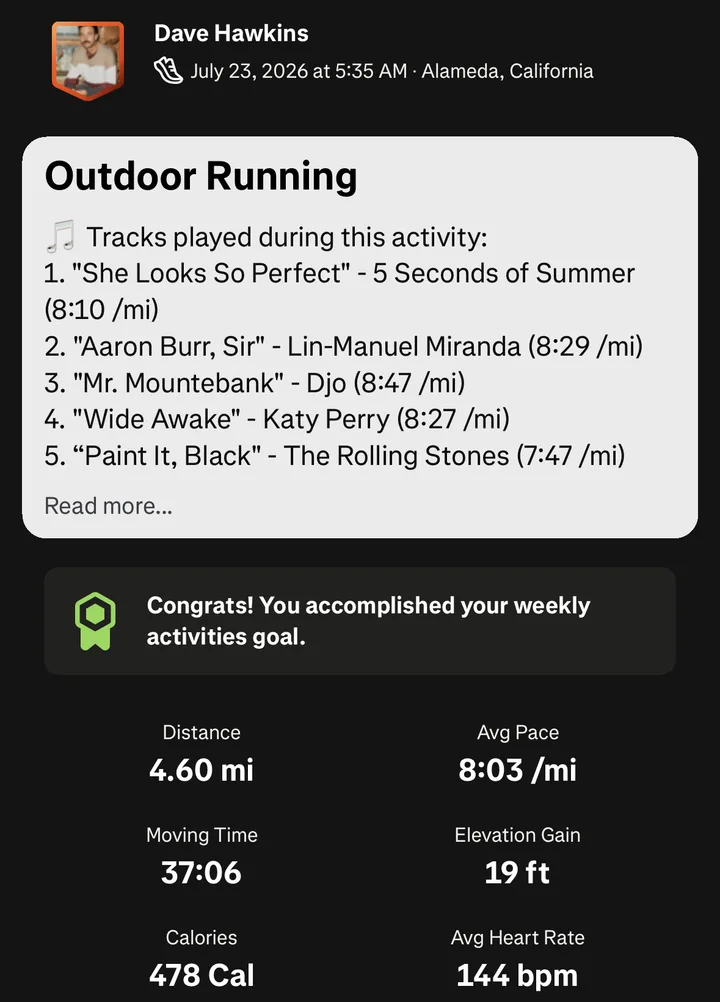
TrackTunes connects your Strava account to Spotify, or to Apple Music in its iPhone app. After each activity it finds what you played during it, works out your pace while each song was on, and writes that tracklist into the Strava activity’s description. That’s the only thing it changes on Strava. Over time it ranks the songs you consistently run faster to (Power Songs) and builds playlists matched to your stride (Cadence Mixes).
So which songs make you run faster? TrackTunes’ answer is that it’s personal: a song counts only when it lifts your pace above the rest of the same run, measured across at least three separate activities. Measured the same way across its users, the top song for speeding up was The Cardigans’ My Favourite Game.
Strava itself doesn’t do this. Its help page says Strava has discontinued its Spotify integration in the Record activity experience, and that you can still listen with the Spotify app. Dave launched TrackTunes in May 2025 and builds it on his own in Denver. It runs on the web and as apps for iPhone and Android, and the first 15 activities are free. He answered our questions in writing.
A marching band kid on a treadmill
We asked whether a particular run, or moment, got him started on TrackTunes.
I first got into running in the early 2010s. During the winter I would train on a treadmill in my office’s gym and I remember “discovering” that running on the beat allowed me to maintain higher paces than I would otherwise trend towards. Maybe this was instilled in me as having been a marching band kid in high school and always having to step on the beat. I just knew that this could be a powerful training (and racing) tool for me but always struggled to find enough songs that “worked”. TrackTunes solves that problem for me by keeping track of all my eclectic listening and letting me pull songs from certain BPM ranges into playlists of songs that span years.
Power Songs, and why your fastest run’s playlist isn’t the answer
The obvious way to find your fastest songs is to look at what played on your fastest runs. Power Songs doesn’t do that. We asked how it works, and what the data has shown him.
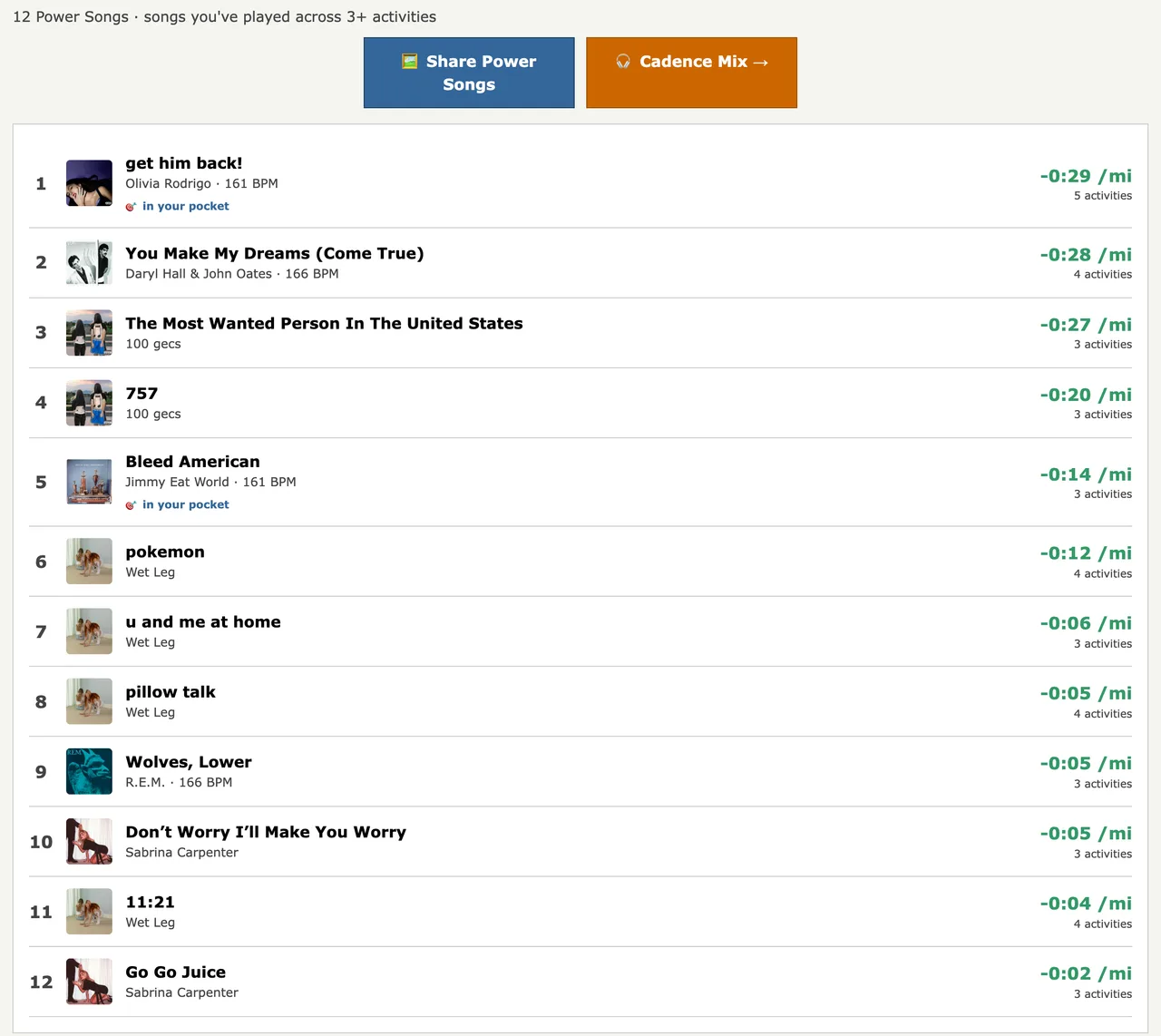
Power Songs frankly came to me from Olivia Rodrigo. A couple of her songs always seemed to give me a huge boost. I wondered if there were others. Power Songs account for the effect of a single song vs. only the run during which it was played. In other words, songs that played during a fast run don’t automatically count as Power Songs. A Power Song lifts your pace above the average for that run while it’s playing, consistently each time you listen to it.
Every month I publish the top listened to songs that month, and in a sea of new releases, somehow Mr. Brightside is always there. I just think it’s so interesting that of all the music ever made, this one song from 2004 consistently breaks into the top 5. (and it’s not just one person with it on repeat either! ha)
His write-up of the feature adds the threshold: a song has to turn up in at least three separate activities before it can qualify, and each play is measured against the rest of the same activity, so a hilly run judges its songs against its own slower baseline.
The app’s blog runs the same idea across its users. In The Last Miles (September 2026), the median song tempo across 165 marathons logged with TrackTunes held at 123 BPM from the first quarter to the last. The songs runners played most in the final quarter of runs of 10 miles or more weren’t the ones they sped up to. Measured against the rest of the same run, the top song for speeding up was The Cardigans’ My Favourite Game: a 4.5% median lift, with 80% of the runners who played it going faster (a song needed at least 15 different runners to make that list).
Where the BPM comes from
On November 27, 2024, Spotify stopped giving new apps (and apps still in development mode) its Audio Features data, which includes each track’s estimated tempo. So where does a song’s BPM come from in TrackTunes, and when does a track count at half or double time?
TrackTunes analyzes the actual audio itself using relatively well-known signal processing techniques to determine a song’s BPM. If the song’s BPM is approximately half or double the athlete’s cadence, TrackTunes assumes they were moving at double or half-time respectively. Have you ever tried running to a song that’s in 3/4 time or mixed meter? Now that’s a mind melt!
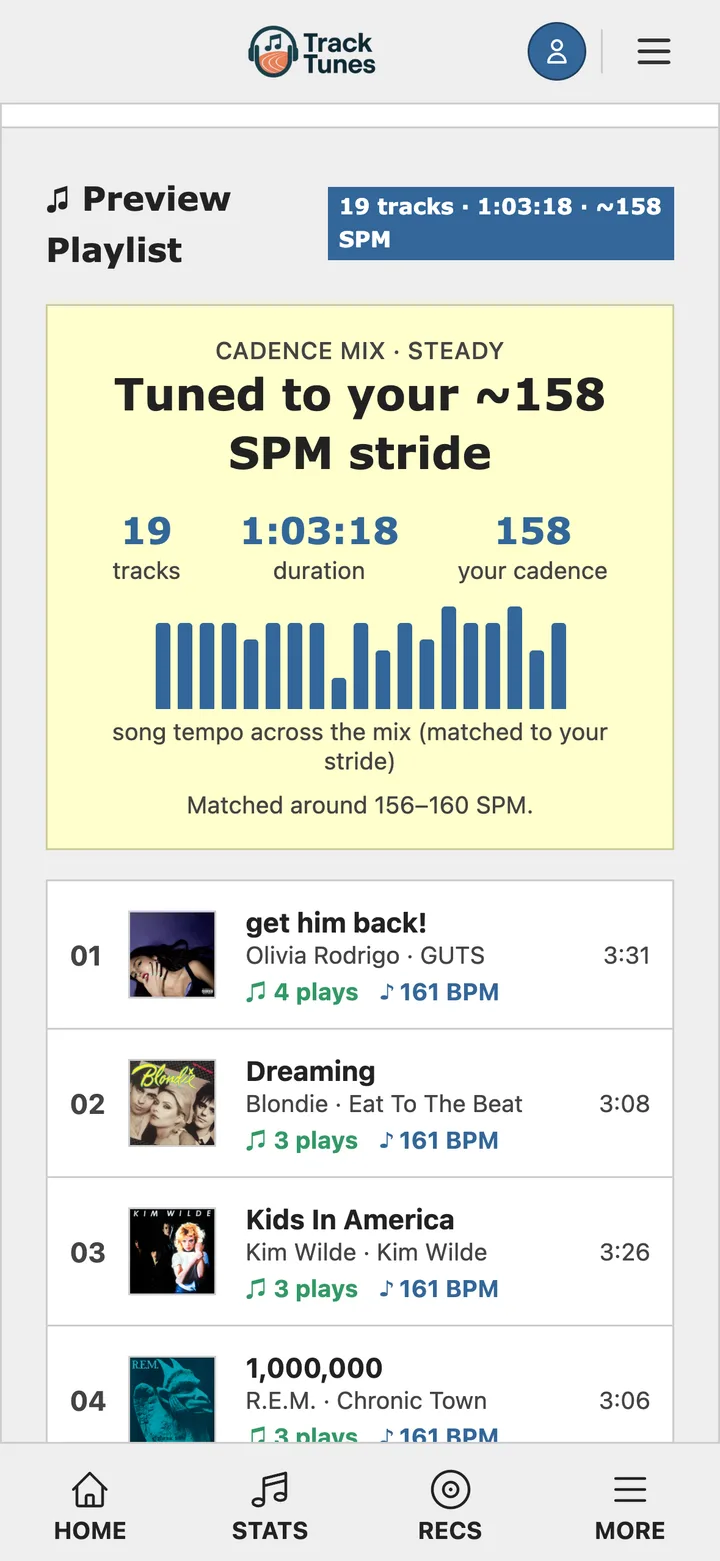
That’s what lets a Cadence Mix count a 79 BPM track for a 158 steps-per-minute stride. The mixes come in four presets (Easy, Steady, Tempo, Intervals) and are built from songs you’ve already run to. For Spotify listeners, each mix is saved to your Spotify account, Dave told us, so it’s there wherever you listen.
The 50-song window
Spotify’s recently played endpoint returns at most 50 tracks, and TrackTunes’ FAQ puts that at roughly two and a half hours of music. A run reaches Strava whenever the watch syncs. So what happens with a three-hour run, or one uploaded the next morning?
This is a Spotify limitation that TrackTunes just has to work within. For really long activities or activities that are uploaded a significant time after completion, TrackTunes pulls the most recent 50 tracks from Spotify and syncs as many as possible. For best results upload your activities soon after finishing!
Two more from the FAQ: music played offline on a Garmin watch only reaches Spotify once the watch syncs with the Spotify app on your phone, so sync it before the run reaches Strava if you can; and podcasts don’t show up at all.
For builders: small scopes, and the album art he can’t post
TrackTunes sits on two platforms it doesn’t control. We asked how that shapes the way he builds, and what he’d most like either of them to open up.
Building on somebody else’s platform means being prepared for change. I try to keep my scopes as small as possible to make the app fun and worthwhile. I’d love to allow athletes to have the album art from their soundtrack uploaded to Strava if they wanted, but Strava keeps their image integration pretty locked down :)
On Strava, the Connect button asks to read your profile and activities and to write to them; the write is the description and nothing else, per the FAQ. Private “Only You” activities stay out unless you switch them on.
After the summit, the stores
In October 2025, five months after launch, TrackTunes won the Up & Coming App Award at Strava’s first Developer Summit in San Francisco, according to TrackTunes’ own write-up (our summit recap has the rest). The iPhone and Android apps came after. What changed, and why go native now?
The Summit was so fun! I was really glad to be invited and meet so many other developers. I ran multiple polls of “what should I build next” and mobile app kept coming out on top! I also was getting a lot of messages like “I can’t find your app in the store” and I decided it would be a good place to be.
If you’ve never paid attention to what you run to
I believe most runners hold their running playlists as precious and sentimental curations. And I get it, we form deep emotional and nostalgic relationships with music over time, and ritual/routine can become almost sacred when training for a big goal. I would offer the suggestion to try getting out of your usual! Try listening to an unfamiliar genre, put on some downtempo folk while you try to keep it chill on a Zone 2 run, or my personal favorite, pick an album and run it top to bottom!
Quick facts
In his words, TrackTunes is “your Strava activities, with the music you moved to.” He put it at nearly 900,000 tracks logged when he wrote (“I can’t wait to hit a million!”); the homepage now says 900,000+.
| At a glance | TrackTunes |
|---|---|
| Free trial | Your first 15 activities, no card: tracklists in your Strava descriptions, pace for every song |
| TrackTunes plan | $20 a year ($19.99 in the App Store and Google Play): unlimited activities, full history, the full Power Songs ranking and Cadence Mixes, a supporters’ Discord |
| Music | Spotify, free or Premium, on the web, iPhone and Android; or Apple Music in the iPhone app, with a subscription, started from its Play tab; one at a time; no podcasts |
| Which way data flows | Reads Strava activities and your Spotify listening history (or, with Apple Music, the songs you play in the app); writes the tracklist into the Strava description |
| Where it runs | The web, an iPhone app and an Android app, one account |
| Made by | Dave Hawkins, Denver, on his own; launched May 2025 |
The rest, including how Apple Music works, is on the TrackTunes listing.
Sources
- Written answers from Dave Hawkins, October 16, 2026, quoted as he wrote them with one typo fixed
- TrackTunes: its pricing, FAQ, privacy policy, about and press pages (screenshots from the press kit), checked October 16 and November 3, 2026
- On its blog: Power Songs, The Last Miles and My Experience at the Inaugural Strava Developers Summit
- TrackTunes on the App Store and on Google Play
- Strava Support: Spotify and Strava
- Spotify for Developers: Introducing some changes to our Web API (November 27, 2024), Get Track’s Audio Features and Get Recently Played Tracks
- Strava Developers: Authentication (what each permission covers)
- Strava Developers Summit event listing (October 23, 2025; the date only)