Pelaris is adaptive coaching for lifting, running and swimming. It builds a periodized program for one of those or all three, then adjusts it as you log sessions and check in. Tracking is free, with no card, and every new account gets one full AI program and a month of it adapting: the first two weeks are written when you build the program, and about a week in the coach writes the next two from how you trained. After that, the free plan brings a fresh program about every six months, and a program that keeps adapting takes a paid plan from A$15 a month (on the web, the same numbers in US dollars, euros and pounds).
It runs on the web, on iPhone and Android, and inside ChatGPT and Claude. The iPhone and Android apps and the ChatGPT connector arrived on August 20, 2026. Spring Tide (version 1.2.0), which Pelaris calls its first full release, shipped on September 19 and brought paid plans from general availability on October 1. Brad builds it in Melbourne.
What made you start Pelaris, and what carried over to a consumer app (and what didn’t)?
I wanted to find out how far AI could be pushed, and not just the models. The workflows around them and the interface on top of them. Enterprise work gives you scale, but it also gives you constraints, so Pelaris became the place to run the experiments that could not be run inside a large company.
What carried over is the platform discipline: secure, scalable and governable from day one. Server-side first, personal data scrubbed before anything touches a model, infrastructure as code, a CI/CD pipeline that largely runs itself. That standard is the same whether the user is a 460-application enterprise or one athlete with a marathon in 14 weeks.
What did not carry over is design. Consumer UI and UX is a different discipline, and it matters far more. An enterprise user will tolerate a clunky screen because they have to use it. An athlete at 6am will not. The interface is most of the product, and the coaching intelligence counts for nothing if the session view is confusing.
In April, a single model call beat your five-layer pipeline in testing. What did that change about how you build, and has anything from the old pipeline found its way back?
AI moved a long way in a short time. The five layers were built for models that needed scaffolding, and by April the scaffolding was in the way. The guidance and guardrails written to keep models on track were now causing confusion and adding complexity for models that no longer needed the help.
The result was Moonshot, which shipped with Open Water on 17 April. We moved program generation to a ReAct framework. Instead of forcing the model through fixed stages, we let it do what it is best at, which is reasoning, and gave it reusable tools to act with. Build a strategy, pull a methodology’s constraints, check an athlete’s history, validate a week. The model decides the order, and the athlete watches the coach think in real time.
The foundations the five layers laid are still there. The methodology rules, the validation, the context snapshot that feeds every coaching interaction all survived. What changed is that the orchestration got simpler, and we now lean on the models improving rather than fighting them. Losing that test was the best outcome we could have had. Less code to maintain, and a better coach.
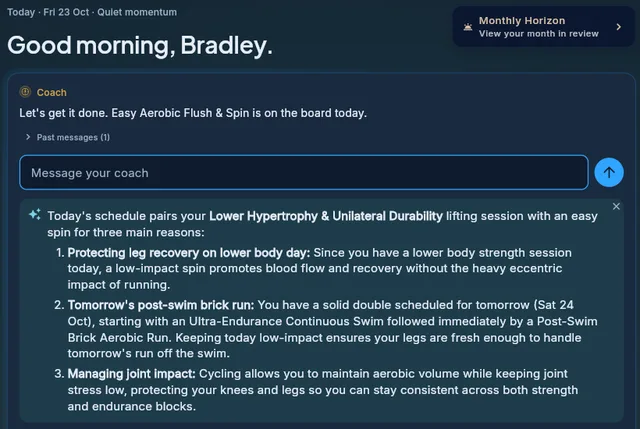
Is lifting and running in the same week, or a sport alongside a marathon, what people ask the coach about most? And what do new athletes want to know before they trust the plan?
Yes, and it is a big segment that nobody serves well. People love playing sport. The social side, the competitive side, the Saturday match. They also want to chase big individual goals, a marathon, a powerlifting total, a triathlon. Most apps make you pick one. Pelaris is built so you can do both, and the plan knows which one wins when they collide.
What new athletes want to know before they trust the plan comes down to three things. First, that their goals are respected. If the football match on Saturday is the priority, nothing in the week should compromise it. The long run moves, the leg day gets lighter, the deload lands where it needs to. Second, that the plan fits the time they actually have, not the time an ideal athlete has. Third, what happens when something goes wrong. A niggle, a missed week, a cold. The coach has to adjust the load rather than guilt-trip them. Once an athlete sees the coach make those calls correctly without being asked, trust follows quickly.
Brad uses Pelaris himself, for his own endurance running and swimming goals.
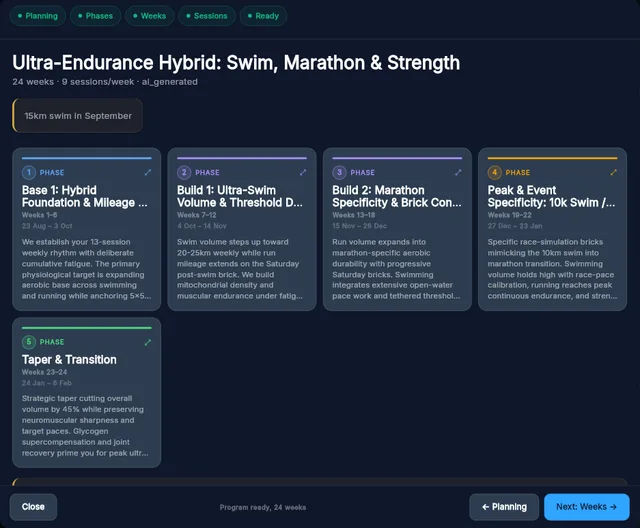
Since August you’ve been on the App Store, Google Play and ChatGPT’s directory, with comparison pages against Hevy, Strong, Fitbod and JEFIT. Where do most new athletes find you now, and did any of those surprise you?
The ChatGPT and Claude connectors are the fastest growing source of new athletes, and the most surprising. We knew people would want MCP connectors. What we expected was that they would find us on the website, sign up, then connect their assistant. What is actually happening is that discovery, sign-up and onboarding are all happening inside the frontier chat tools. Someone asks ChatGPT or Claude for a training plan, finds Pelaris in the directory, and is through intake before they have ever seen pelaris.io.
The app stores and the comparison pages do their job, but the connectors changed how we think about distribution. The front door is wherever the athlete already is.
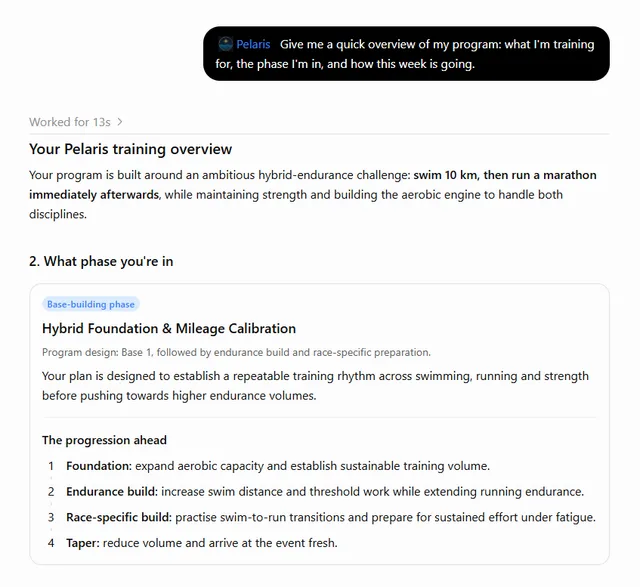
An assistant gets 29 Pelaris tools: 13 read your data and 16 change it, such as logging a workout or moving a planned session. More on how it and other apps plug into assistants in connecting Strava to Claude and ChatGPT.
Where does Strava sync stand under Strava’s new API terms, and what else can athletes connect?
I wrote about this in July: The great AI lockdown has begun. Reddit was the early, high-profile example, and Garmin and Strava have since moved in the same direction. Open APIs were the bedrock of the last decade of fitness software, and AI is changing the economics of that for every platform. We understand why. We also believe every athlete should be able to use their own data however they need to, and that is the position Pelaris takes.
Strava sync is live and working, and we are talking with Strava and other platforms about the right way forward under the new terms. Alongside it, Pelaris connects to Apple Health and Health Connect, connects directly to Polar and Wahoo devices, and accepts FIT and CSV imports, so no athlete is ever locked out of their own history.
His July essay is The great AI lockdown has begun, on bradleyhunt.ai. Pelaris’s integrations page shows Strava as connected, with activities syncing automatically, and still lists Wahoo as coming soon, once Wahoo completes its partner review. Since he answered, Garmin Connect has gone live: activities arrive after the watch syncs, and planned sessions can be sent to the watch. FIT files from any watch or bike computer now import too. From Strava, Pelaris imports a summary of each activity (sport, date, duration, distance, heart rate, pace, cadence, power and elevation gain), and no GPS coordinates or route data.
A code for our readers
Brad gave our readers a code: APPS4STRAVA26 takes 50% off the first 12 months of any Pelaris plan, monthly or annual, for new subscribers. Enter it at checkout on pelaris.io. It’s also on our deals page.
Quick facts
Brad says Pelaris opened in early access in February 2026, with Open Water in April as its first named release.
| At a glance | Pelaris |
|---|---|
| What it does | Builds one periodized program across lifting, running, swimming and other sports, then rewrites it as you log sessions and check in |
| Free (Beach) | Logging, full history, charts, PRs, CSV export, the coach conversation, Pelaris in ChatGPT and Claude, a fresh program about every six months and a body scan about every three; new accounts start with one full AI program and a month of it adapting, no card |
| Pelaris Ocean | A$15 a month or A$120 a year (US App Store: $14.99 or $119.99): a fresh AI program and an AI body scan (from a photo or two) each month, always adapting (next week written from this week) |
| Pelaris Horizon | A$20 a month or A$160 a year (US App Store: $19.99 or $159.99): unlimited programs and body scans |
| Strava sync | Live; activities sync automatically |
| What it reads from Strava | An activity summary (sport, date, duration, distance, heart rate, pace, cadence, power, elevation gain), no GPS or routes |
| Other connections | Garmin Connect (activities in, planned sessions out to the watch), Polar, Apple Health and Health Connect (Wahoo listed as coming soon); FIT file import; history import from Hevy or Strong (CSV) |
| Where it runs | Web, iPhone and iPad (iOS 16 or later), Android, and inside ChatGPT, Claude, Grok, Gemini, Le Chat and other MCP clients |
| Made by | Bradley Hunt, in Melbourne |
The rest is on the Pelaris listing. Another maker’s view: our Q&A with YOUB’s co-founder on whether AI can replace a running or cycling coach.
Sources
- Written answers from Bradley Hunt, email to Apps for Strava, October 22, 2026, quoted as he wrote them, including the reader code
- Pelaris: its pricing, integrations, About and privacy pages, the body scanning page, the assistant tools list, Pelaris for Garmin, and the guides to importing FIT files and switching from Hevy or Strong, the free coaching month help page, checked November 8, 2026
- Pelaris blog, including lifting and running in the same week (October 13, 2026), a sport and a marathon (October 8, 2026), Open Water and Moonshot (April 17, 2026), the apps and ChatGPT launch (August 20, 2026), Spring Tide (September 19, 2026)
- Pelaris on the App Store (US prices, requirements, version history) and on Google Play
- bradleyhunt.ai, and his essay The great AI lockdown has begun (July 17, 2026)